Equity and Buildings: A Practical Framework for Local Government Decision Makers
Explore strategies to integrate equity into building policies, strengthen community participation, and create healthier, more affordable, energy-efficient buildings.
Published on 6/18/2021
Report
Equitable Building Electrification
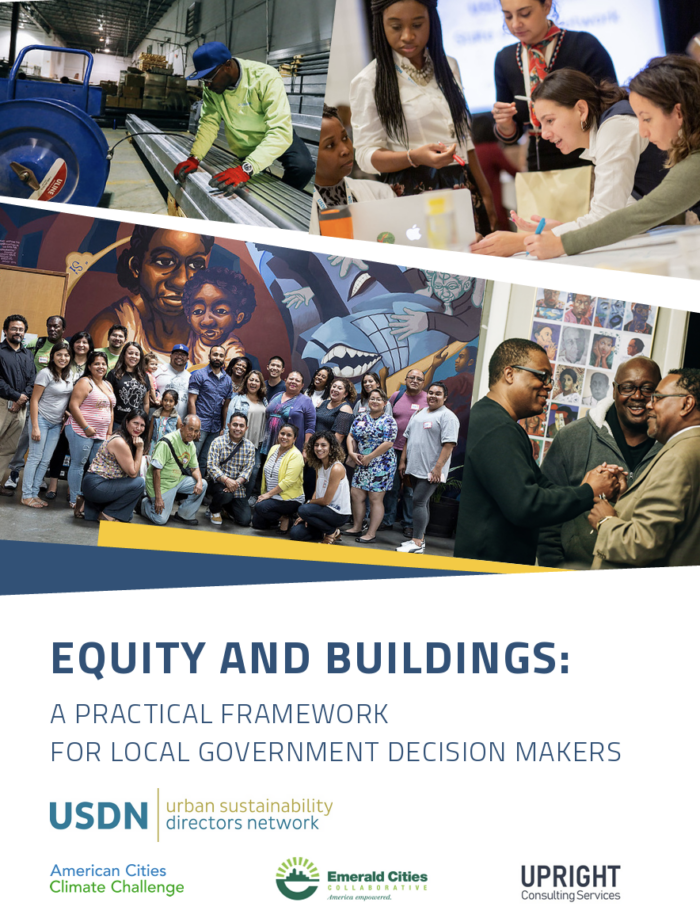
Developed through a partnership involving the Urban Sustainability Directors Network (USDN), Emerald Cities Collaborative (ECC), and other contributing organizations, Equity and Buildings: A Practical Framework for Local Government Decision Makers, provides practical guidance for integrating racial and social equity into local building policies, sustainability programs, and climate initiatives.
The framework recognizes that buildings shape more than energy use and carbon emissions. They also influence housing affordability, public health, economic opportunity, and community resilience. By centering the experiences and priorities of communities historically excluded from decision-making, local governments can develop building policies that deliver broader, more equitable benefits.
Designed for local government staff, sustainability professionals, and community partners, the resource combines guiding principles, policy considerations, real-world examples, and reflection questions to help translate equity commitments into meaningful action.
What’s Inside the Resource
The framework offers guidance for incorporating equity throughout building policy development and implementation.
- Equity Fundamentals: Introduces 12 guiding principles for equitable building policies, including community leadership, shared decision-making, transparency, accountability, and addressing systemic barriers.
- Community Engagement and Partnerships: Explores strategies for building trust, understanding community priorities, strengthening relationships, and ensuring residents have a meaningful role in shaping policies that affect their neighborhoods.
- Housing Affordability and Stability: Examines how building improvements can support affordable housing while addressing displacement risks and protecting existing residents.
- Health and Community Well-Being: Highlights connections between building conditions, indoor environmental quality, public health, and healthier living environments.
- Economic Inclusion: Explores opportunities to connect sustainable building investments with quality jobs, local contracting opportunities, and community wealth-building.
- Climate and Community Resilience: Addresses how building policies can strengthen preparedness for extreme weather, environmental hazards, and other disruptions.
- Funding and Implementation: Provides considerations for financing equitable building initiatives, coordinating across government departments, and identifying next steps.
Why It Matters
Building decarbonization presents an opportunity to improve the places where people live, work, and gather. However, without intentional planning and community participation, investments can reinforce existing inequities or leave historically underserved communities without access to their benefits.
This framework encourages local governments to move beyond emissions reductions alone and consider how building policies affect affordability, health, economic stability, and community decision-making.
By connecting climate goals with equity-centered planning, the resource helps policymakers and community partners develop strategies that reduce environmental impacts while creating healthier buildings, stronger local economies, and more resilient neighborhoods.